
Content reviewed by:
Alex Shulman
New York City is always building.
New towers rise over Midtown. Long Island City keeps adding glass, steel, and concrete. Downtown Brooklyn changes block by block. Crews work above sidewalks, inside trenches, around hoists, beside heavy equipment, and on scaffolds, where one mistake can lead to a life-changing fall.
The public record shows where those risks keep showing up.
This article uses the NYC Open Data Construction-Related Incidents dataset, which includes construction-related incidents recorded through the Department of Buildings Incident Database.
The dataset includes location fields, boroughs, ZIP codes, injury counts, fatality counts, incident dates, and incident cause categories, which makes it useful for mapping where construction-related risk appears most often across the city.
What This NYC Construction Injury Map Measures
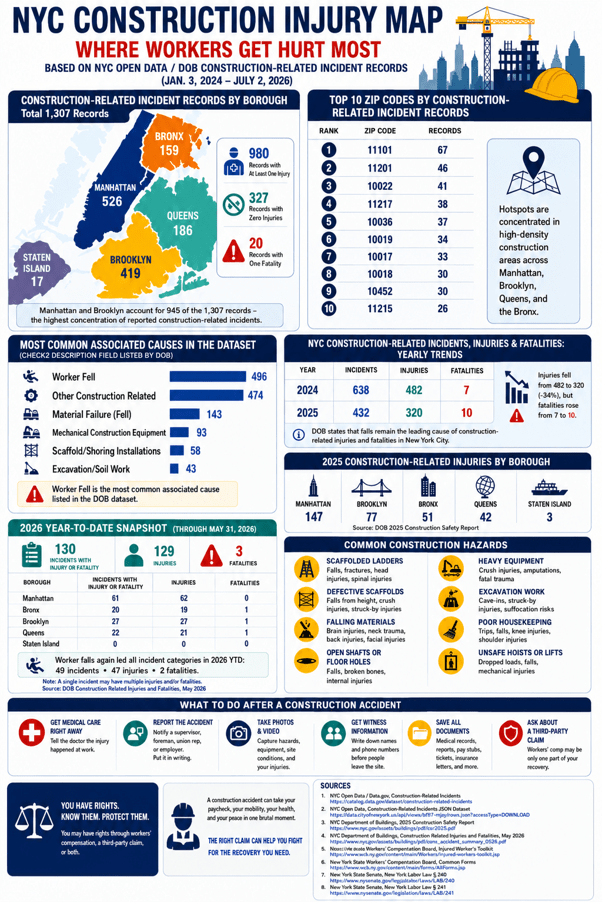
The dataset reviewed for this article showed 1,307 construction–related records from January 3, 2024 through July 2, 2026. Not every record lists an injury. The dataset’s injury field shows 980 records with at least one injury, while 327 records list zero injuries. The fatality field shows 20 records with one fatality.
That means the tables below should be read as construction–related incident records, not as a pure count of injured workers. They are still valuable because they show where Department of Buildings construction-related reports are clustering across the city.
NYC Construction-Related Incident Records by Borough
Manhattan and Brooklyn lead the map by a wide margin.
| Borough | Construction-Related Records |
|---|---|
| Manhattan | 526 |
| Brooklyn | 419 |
| Queens | 186 |
| Bronx | 159 |
| Staten Island | 17 |
Manhattan and Brooklyn account for 945 of the 1,307 records in the dataset reviewed. That does not mean every site in those boroughs is unsafe.
It means the public records point to the heaviest concentration of reported construction-related incidents in the same boroughs where dense development, high-rise work, renovations, scaffolds, cranes, sidewalk sheds, and overlapping contractors are part of daily life.

NYC Construction Hotspots by ZIP Code
The ZIP code view makes the map more local.
| Rank | ZIP Code | Construction-Related Records |
|---|---|---|
| 1 | 11101 | 67 |
| 2 | 11201 | 46 |
| 3 | 10022 | 41 |
| 4 | 11217 | 38 |
| 5 | 10036 | 37 |
| 6 | 10019 | 34 |
| 7 | 10017 | 33 |
| 8 | 10018 | 30 |
| 9 | 10452 | 30 |
| 10 | 11215 | 26 |
The top ZIP codes are concentrated in high-density construction areas across Manhattan, Brooklyn, Queens, and the Bronx. For workers, these numbers matter because a serious job site accident may involve far more than one employer.
The site address, permit holder, general contractor, subcontractors, equipment providers, property owner, and safety setup may all become important after an injury.
The Most Common Construction Incident Causes in the Dataset
The most common associated cause listed in the DOB dataset is Worker Fell, with 496 records. That is followed by Other Construction Related, Material Failure (Fell), Mechanical Construction Equipment, Scaffold/Shoring Installations, and Excavation/Soil Work.
| Associated Cause Listed by DOB | Records |
|---|---|
| Worker Fell | 496 |
| Other Construction Related | 474 |
| Material Failure (Fell) | 143 |
| Mechanical Construction Equipment | 93 |
| Scaffold/Shoring Installations | 58 |
| Excavation/Soil Work | 43 |
Falls stand out for a reason.
A ladder shifts. A scaffold plank gives way. A worker steps near an unguarded floor opening. A harness is missing, badly fitted, or attached to the wrong anchor point. A roof edge is left exposed.
One second changes everything.
The Department of Buildings’ 2025 Construction Safety Report also points to falls as one of the city’s core construction dangers, stating that the department continues to center much of its safety strategy on fall protection practices.
NYC Construction Injuries Fell in 2025, But Fatalities Rose
The broader citywide trend has two sides.
DOB’s 2025 Construction Safety Report shows 432 construction–related incidents, 320 injuries, and 10 fatalities in 2025. That was a drop from 638 incidents and 482 injuries in 2024, but fatalities rose from 7 in 2024 to 10 in 2025.
| Year | Incidents | Injuries | Fatalities |
|---|---|---|---|
| 2024 | 638 | 482 | 7 |
| 2025 | 432 | 320 | 10 |
That is the hard truth behind a safer-looking year. Fewer reported injuries is good news. Ten deaths is not.
DOB’s 2025 borough-level injury table showed Manhattan with the highest injury count, followed by Brooklyn, the Bronx, Queens, and Staten Island.
| Borough | 2025 Construction-Related Injuries |
|---|---|
| Manhattan | 147 |
| Brooklyn | 77 |
| Bronx | 51 |
| Queens | 42 |
| Staten Island | 3 |
2026 Year-to-Date Snapshot
DOB’s May 2026 construction injury and fatality summary showed 130 incidents with injury or fatality, 129 injuries, and 3 fatalities through May 31, 2026. The same DOB summary notes that a single incident may have multiple injuries and/or fatalities.
| Borough | 2026 YTD Incidents With Injury or Fatality | 2026 YTD Injuries | 2026 YTD Fatalities |
|---|---|---|---|
| Manhattan | 61 | 62 | 0 |
| Bronx | 20 | 19 | 1 |
| Brooklyn | 27 | 27 | 1 |
| Queens | 22 | 21 | 1 |
| Staten Island | 0 | 0 | 0 |
Worker falls again led the 2026 year-to-date incident categories in DOB’s May report, with 49 incidents with injury or fatality, 47 injuries, and 2 fatalities through May 31, 2026.
Why Construction Workers Get Hurt in NYC Hotspots
Construction danger grows when risk gets stacked.
In dense parts of Manhattan, Brooklyn, Queens, and the Bronx, workers may be operating beside open businesses, subway entrances, apartment buildings, schools, bike lanes, truck loading zones, and crowded sidewalks.
Contractors may be sharing the same tight site. Crews may be racing schedules. Safety meetings may be rushed. Equipment may be moved before anyone takes photos. A hazard that should have been fixed in the morning can become a hospital visit by lunch.
Common job site hazards include:
| Hazard | What Can Happen |
|---|---|
| Unsecured ladders | Falls, fractures, head injuries, spinal injuries |
| Defective scaffolds | Falls from height, crush injuries, struck-by injuries |
| Falling materials | Brain injuries, neck trauma, back injuries, facial injuries |
| Open shafts or floor holes | Falls, broken bones, internal injuries |
| Heavy equipment | Crush injuries, amputations, fatal trauma |
| Excavation work | Cave-ins, struck-by injuries, suffocation risks |
| Poor housekeeping | Trips, falls, knee injuries, shoulder injuries |
| Unsafe hoists or lifts | Dropped loads, falls, mechanical injuries |
A serious construction accident is rarely just “bad luck.” It may trace back to an unsafe ladder, missing guardrail, weak site supervision, poor training, ignored complaints, bad staging, defective equipment, or pressure to work fast at the cost of safety.
Workers’ Comp After a NYC Construction Injury
After a job site injury, many workers are told to file workers’ comp.
That may be the right first step, but it may not be the only step.
The New York Workers’ Compensation Board says workers’ compensation provides lost wage benefits and/or medical care for work-related injuries or illnesses, and those benefits are available to eligible workers in New York regardless of citizenship or immigration status.
The Board advises injured workers to get medical treatment as soon as possible, tell the provider the injury happened at work, and give the provider the employer and insurer information if known. The Board also advises workers to notify their employer in writing within 30 days if possible and file a claim with the Workers’ Compensation Board.
Workers’ compensation may help with:
| Benefit Type | What It May Cover |
|---|---|
| Medical care | Treatment, prescriptions, equipment, and related care |
| Lost wage benefits | Money paid when a work injury causes wage loss |
| Travel reimbursement | Mileage, public transportation, or needed treatment-related expenses |
| Death benefits | Benefits for eligible surviving family members after a fatal work injury |
The Board says medical care for a work-related injury or illness is provided free of cost for the worker’s lifetime in an established claim, and it explains that treatment-related travel expenses may be reimbursed.
When a Third-Party Construction Claim May Matter
Workers’ comp may not be the whole case.
A third-party claim may exist when someone other than the injured worker’s direct employer helped cause the accident. On a construction site, that may include a property owner, general contractor, subcontractor, site manager, equipment company, maintenance company, or another responsible party.
The Workers’ Compensation Board’s common forms page includes Form C-121, titled Claim for Compensation and Notice of Commencement of Third–Party Action, which is filed with the Board, employer, and insurer within 30 days after a third-party action has started.
That matters because workers’ comp and third-party claims can address different losses.
| Claim Type | What It May Address |
|---|---|
| Workers’ compensation | Medical care, wage benefits, disability benefits, death benefits |
| Third-party claim | Pain and suffering, full wage loss, future lost earnings, long-term damages against non-employer parties |
Every case depends on the facts. The right path may depend on who controlled the work area, who supplied the ladder, who installed the scaffold, who created the hazard, who knew about the danger, and which safety rules applied.
How New York Labor Law May Apply
New York has laws that can be especially important after construction site injuries.
New York Labor Law § 240 applies to scaffolding and other safety devices for workers involved in certain building-related work. The statute refers to contractors, owners, and agents, with exceptions, and lists devices such as scaffolding, hoists, ladders, slings, hangers, blocks, pulleys, braces, irons, ropes, and other devices that must give proper protection to workers.
New York Labor Law § 241 applies to construction, excavation, and demolition work. It requires covered construction areas to be constructed, shored, equipped, guarded, arranged, operated, and conducted in a way that provides reasonable and adequate protection and safety for workers and others lawfully on site.
These laws may become important after falls, scaffold accidents, ladder failures, falling object injuries, unsafe openings, excavation incidents, and other serious job site accidents.
What To Do After a Construction Accident in New York City
The first moves after an accident can protect the worker’s health and the claim.
Get medical care right away. Tell the doctor the injury happened at work.
Report the accident to a supervisor, foreman, union representative, or employer. Put it in writing when possible.
Take photos or video before the site changes. Capture the ladder, scaffold, trench, floor opening, harness, machine, falling object, debris, lighting, weather, or safety condition involved.
Write down witness names and phone numbers. Workers move from site to site, and a key witness may be hard to find later.
Save every document. Keep medical records, discharge papers, employer texts, incident reports, pay stubs, union records, insurance letters, photos, and the names of every contractor on site.
Ask whether a third-party claim exists. Workers’ comp may be only one part of the recovery.
What Evidence Matters Most?
Construction sites change fast.
A broken ladder gets replaced. A scaffold gets repaired. Debris gets hauled away. A hole gets covered. A harness disappears. A contractor writes a version of events that protects the company before the injured worker has even left the hospital.
Useful evidence may include:
| Evidence | Why It Matters |
|---|---|
| Photos and videos | Shows the hazard before the site changes |
| Incident reports | Creates a written record of what happened |
| Witness names | Confirms unsafe conditions or missing safety gear |
| Contractor information | Helps identify non-employer parties |
| DOB records | Shows site activity and safety history |
| Medical records | Connects the injury to the accident |
| Pay records | Supports lost wage claims |
| Equipment details | May show unsafe ladders, scaffolds, hoists, machines, or tools |
The worker may only know the employer’s name. The full case may involve a property owner, general contractor, subcontractor, managing agent, safety company, equipment supplier, or maintenance contractor.
What This Map Means for NYC Construction Workers
The NYC construction injury map does not say every construction site in Manhattan, Brooklyn, Queens, the Bronx, or Staten Island is unsafe.
It says risk is not spread evenly.
Construction-related incident records cluster in the city’s busiest building zones. The top records appear where height, pressure, equipment, heavy materials, crowded streets, and overlapping contractors meet. The public data points to worker falls as the leading associated cause in the dataset, and DOB’s recent reports keep showing that falls remain one of the city’s most serious construction dangers.
For injured workers, the lesson is clear: the location matters. The equipment matters. The contractor chain matters. The site safety setup matters. The DOB record may matter. And the first explanation from an employer or insurance company may not tell the whole story.
Injured on a Construction Site in New York City?
If you were hurt on a construction site, you may have rights through workers’ compensation, a third-party claim, or both. New York workers’ compensation lawyers at Shulman & Hill help injured workers understand their options after ladder falls, scaffold accidents, falling object injuries, equipment incidents, excavation accidents, and other serious job site injuries.
A construction accident can take your paycheck, your mobility, your health, and your peace in one brutal moment. The right claim can help you fight for medical care, lost wage benefits, and the recovery you need.
Methodology
This article uses the NYC Open Data Construction-Related Incidents dataset as a safety-risk snapshot. The dataset reviewed showed 1,307 construction-related records from January 3, 2024 through July 2, 2026.
Since some records list no injury count, borough and ZIP rankings in this article are described as construction-related records unless a table or sentence clearly refers to DOB injury or fatality totals.
The 2025 and 2026 year-to-date injury numbers are taken from DOB’s published construction safety report and monthly injury/fatality summary.
Sources:
- NYC Open Data / Data.gov, Construction-Related Incidents
https://catalog.data.gov/dataset/construction-related-incidents - NYC Open Data, Construction-Related Incidents JSON Dataset
https://data.cityofnewyork.us/api/views/bf97-mjsy/rows.json?accessType=DOWNLOAD - NYC Department of Buildings, 2025 Construction Safety Report
https://www.nyc.gov/assets/buildings/pdf/csr2025.pdf - NYC Department of Buildings, Construction Related Injuries and Fatalities, May 2026
https://www.nyc.gov/assets/buildings/pdf/cons_accident_summary_0526.pdf - New York State Workers’ Compensation Board, Injured Worker’s Toolkit
https://www.wcb.ny.gov/content/main/Workers/injured-workers-toolkit.jsp - New York State Workers’ Compensation Board, Common Forms
https://www.wcb.ny.gov/content/main/forms/AllForms.jsp - New York State Senate, New York Labor Law § 240
https://www.nysenate.gov/legislation/laws/LAB/240 - New York State Senate, New York Labor Law § 241
https://www.nysenate.gov/legislation/laws/LAB/241